


In an open meeting within the “Real Estate People’s Monday Gathering,” the official spokesperson for the General Authority for Real Estate, Mr. Tayseer Al-Mufarraj, reviewed the details of the regulatory bylaw for real estate marketing and advertising , explaining its background and the reasons for its issuance, and directly answering the most prominent questions that have been raised about it since its announcement.
Professor Tayseer Al-Mufarraj began his speech by welcoming the attendees, explaining that this space was exceptionally allocated to discuss the regulatory framework for real estate marketing and advertising, after receiving a large number of questions and inquiries since the framework was published.
He explained that the aim of this meeting was to monitor these questions, understand their nature, and answer them clearly and in detail, noting that among the most prominent questions raised were: Is real estate brokerage activity limited to Saudis only? Can others enter it? And what is the difference between an advertisement published through influencers and an advertisement made through a real estate broker?
Main topics for inquiries
He added that after collecting and analyzing all the questions, it became clear that they focused on three or four main themes, the most important of which are: the difference between advertising and marketing, when content is considered an advertisement or a real estate activity that can only be practiced through a Saudi broker, in addition to the question of whether it is possible to allow non-Saudis to practice real estate brokerage.
He indicated that these points will be answered in detail, but before that, it is necessary to provide an overview of the regulatory framework for real estate marketing and advertising.
He addressed an important question that was frequently asked: Why was this regulation issued at this time? Did it come about due to a specific circumstance? He explained that followers and specialists are aware that the regulation was previously presented through the “Survey” platform last November, about six months ago, and many views and comments were received from various parties, whether from the private sector, individuals, companies, or practitioners, and these views are still preserved in the platform’s archive.
He explained that after the opinion poll phase ended, the regulations were approved by the board of directors of the authority, and then officially published in the “Umm Al-Qura” newspaper to become effective.
Real Estate Brokerage and Services System
He then moved on to discuss the concept of real estate legislation, explaining that it consists of a main system that the Authority prepares and submits for approval according to official procedures, and which is then announced by a decision of the Council of Ministers. He noted that this system requires the issuance of implementing regulations that interpret its articles and provisions.
In this context, the spokesperson for the Real Estate Authority explained that the system related to today’s topic is the Real Estate Brokerage and Services System, which is a comprehensive system that regulates a number of real estate activities, including advertising, marketing, and brokerage of deals, in addition to other services such as facilities management, property management, consulting, analysis, and real estate auctions.
Al-Mufarraj stressed that the existence of these activities requires the issuance of independent regulatory bylaws for each activity, which explains the issuance of previous bylaws such as the Auctions Bylaw, the Consulting and Analysis Bylaw, up to the current Bylaw for Real Estate Marketing and Advertising, noting that other bylaws will be put forward later through a survey platform, then adopted and announced.
He stressed that the current regulations are not new, but were previously proposed several months ago, and today they were officially approved.
Three fundamental pillars of the regulations
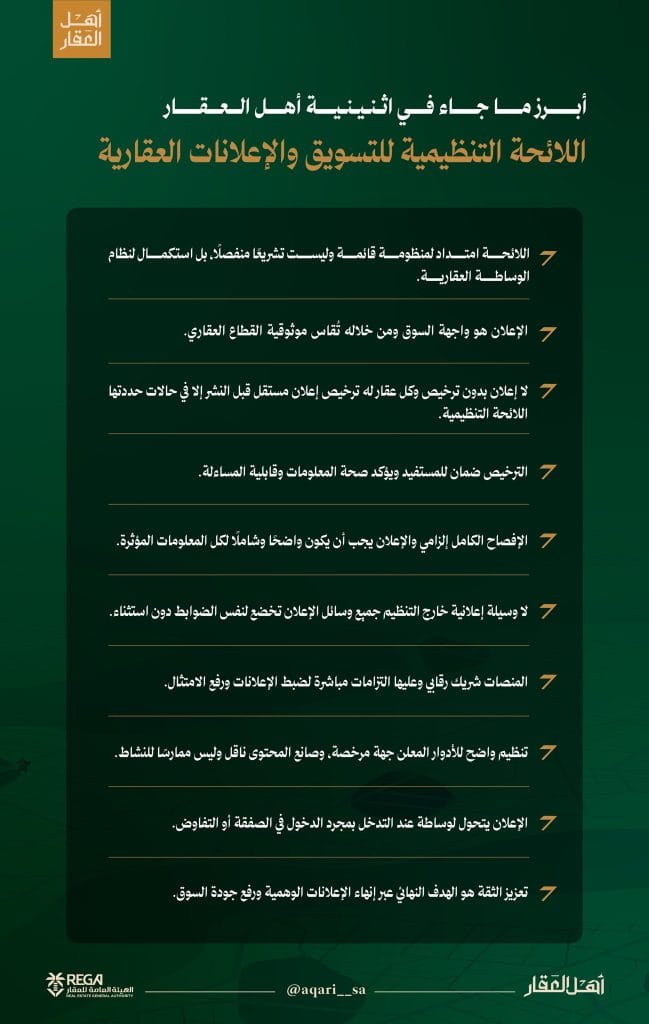
He explained that the regulations are based on three main pillars:
The first pillar is prior authorization.
No real estate advertisement may be published before obtaining a license issued by the Authority. This license is separate from the business license (the "Fal" license) and is granted for each property individually. He noted that a practitioner needs a business license, a brokerage contract, and a separate advertising license for each property.
He explained that the reason for requiring a license for each property is due to the difference in properties in terms of location, price and description, which requires ensuring that each advertisement is based on accurate and reliable data from real estate records, with the license number highlighted in the advertisement to enable verification.
He also explained that there are cases that do not require a separate advertising license, such as real estate contributions, off-plan sales and leases, or auctions, where a project or auction license is sufficient.
The second pillar is full disclosure.
The regulations include a set of mandatory data that must be included in the advertisement, such as the rights associated with the property, its description, location, condition, related services, and any existing disputes, in addition to contact information that matches the license, the advertiser’s name, the advertising license number, its expiry date, and the practice license number.
He pointed out that it is sufficient to place the license number along with a QR code containing all the details, in order to avoid distorting the appearance of the advertisement.
The third pillar is the immediate removal of the advertisement.
The advertisement must be removed when its purpose is fulfilled or the license expires, with real estate platforms obligated to implement this automatically.
He stressed that the regulation applies to all means of advertising without exception, whether through social media, visual and audio media, exhibitions, billboards, or electronic platforms.
He also explained that the regulation defined advertising broadly to include all content that is published or promoted for a property.
The difference between promotional advertising and real estate activity
Regarding the difference between promotional advertising and real estate activity, he explained that advertising is considered real estate activity if it involves direct communication with clients or acting as an intermediary, which requires a license and is limited to licensed Saudi nationals. Advertising through media outlets or influencers, however, is considered a means of dissemination only, provided that the license number is displayed and no intermediary activity is practiced.
He stressed that an unlicensed advertiser is not entitled to receive calls or negotiate with clients, because that is considered practicing brokerage activity.
He pointed out that all advertising methods lead to the licensed real estate broker, as no party can advertise a property without going through an accredited broker who issues the advertising license.
The most prominent prohibitions
He also addressed key prohibitions, such as publishing false information, using different contact information, defaming others, using official logos without authorization, or providing misleading information about the property. He then discussed the obligations of real estate platforms, explaining that these include technical, regulatory, and operational aspects, such as linking the platform to the regulatory authority, verifying licenses, removing unauthorized advertisements, and providing channels for complaints.
He pointed out that some cases do not require a separate advertising license if there is a comprehensive license for the project, provided that the license number and basic information are displayed. Regarding violations, he explained that penalties are applied according to approved schedules, starting gradually and potentially reaching substantial fines. Licenses can be revoked in two cases: first, if the information submitted with the advertisement license is found to be false, or second, if the advertisement contains information not included in the license.


