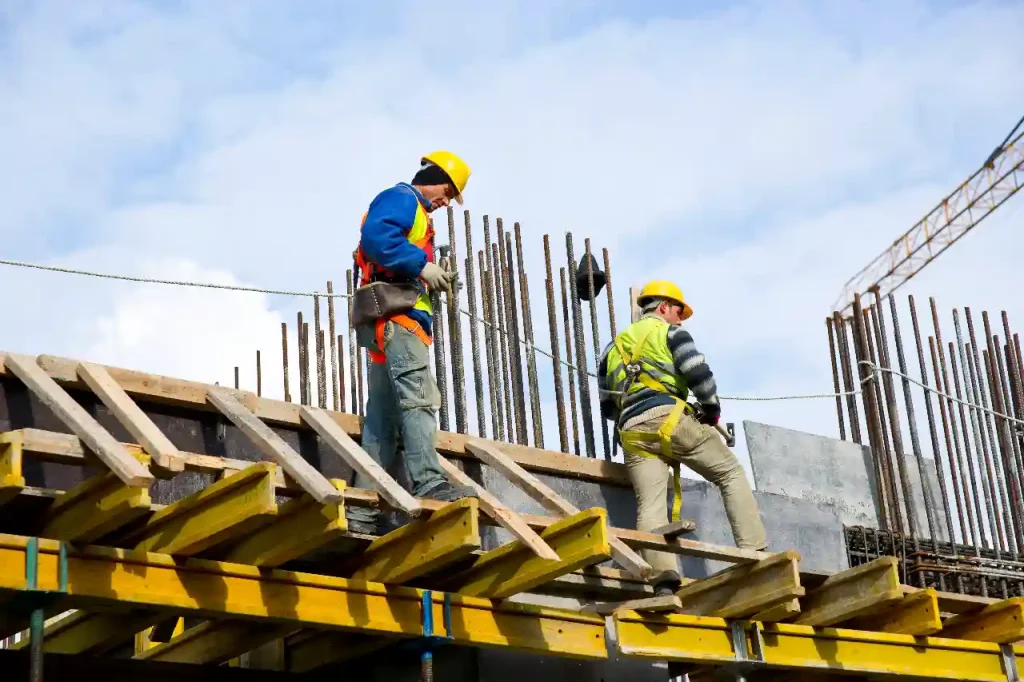

The most common misconception in the minds of some contractors is that safety is a budget item to boost profit. The equation is completely reversed. Safety is not a burden, but silent capital, generating revenue in a way that doesn't show up in the direct budget, but is accurately measured in the overall project account.
Start with the global figure. The International Labor Organization has estimated the economic cost of occupational accidents and diseases at 4% of global output, equivalent to approximately $2.8 trillion annually. A recent Takala study published in 2024 raised the estimate to 5%. These are not round numbers, but estimates based on insurance data, lost work days, family compensation, and lost productivity.
Locally, the General Authority for Statistics bulletin recorded 245 occupational injuries and 1.3 deaths per 100,000 workers. The construction sector accounts for a higher than average share of the population in all these figures, due to the nature of the work and the high risk factor.
Each accident, despite its apparent simplicity, generates six layers of cost, not four:
Direct treatment and compensation is the cheapest. Then the site shutdown and the freezing of labor and equipment. Then administrative investigations and inspection visits. Then the statutory fines that reach up to 25,000 riyals for a violation, multiplied by the number of workers. Then - and this is subtle - the increase in insurance premiums by 15-30% per year, a figure that haunts the facility for years after the accident. And finally, the toughest layer of all: Reputation. The client pulls out and doesn't say why. Doors close silently. The contractor does not realize that his record, which he tolerated two years ago, is now being judged in closed rooms that he does not enter.
In contrast, the Liberty Mutual Workplace Safety Index, produced by America's largest insurance company for a quarter century, confirms that every dollar spent on preventive safety programs returns a savings of between four and six dollars.
In contrast, the Liberty Mutual Workplace Safety Index, produced by America's largest insurance company for a quarter century, confirms that every dollar spent on preventive safety programs returns a savings of between four and six dollars.
<The OSHA Institute puts the direct cost of an average work injury in the construction industry at about $40,000, doubling in indirect costs.
In construction leaders, we include this reading in every feasibility study we prepare for the owner, not as an ethical item, but as an economic item on which to base the decision to select a contractor.
A contractor who works with the hope that nothing will happen is building on shifting ground. Serendipity does not work for many years on a construction site. Hope, gentlemen, is not a strategy."
Entrepreneur
Owner of Construction Leaders for Engineering Consulting