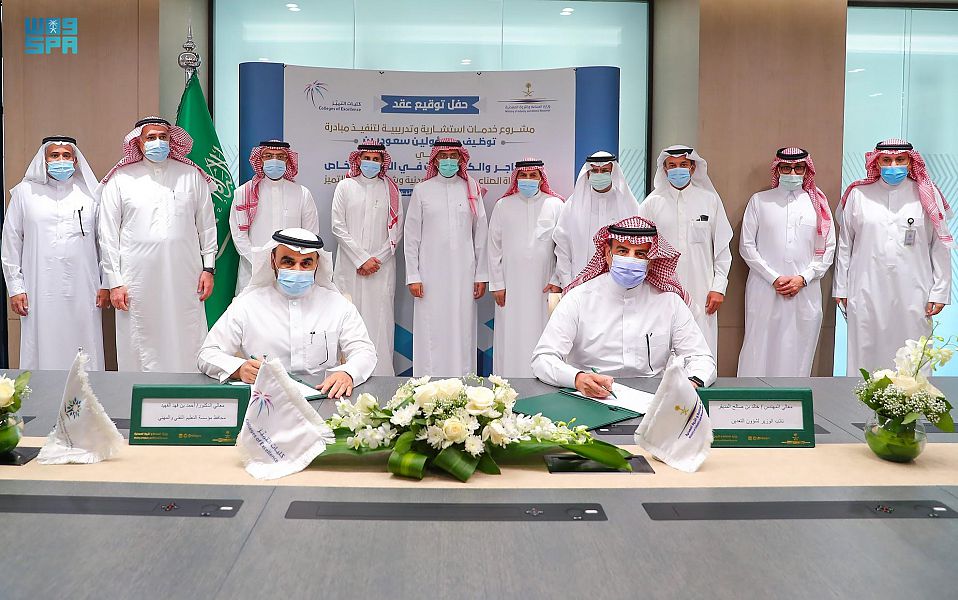
The Ministry of Industry and Mineral Resources launched today an initiative to train and employ 1400 officials in construction materials quarries and crushers, as part of its efforts to achieve the objectives of the comprehensive mining strategy, which includes creating job opportunities for citizens, where the project contract was signed by HE Deputy Minister for Mining Affairs Engineer Khalid bin Saleh Al Madifar and HE Governor of the Technical and Vocational Training Corporation and Chairman of the Board of Directors of Excellence Colleges Company, Dr. Ahmed bin Fahd Al Fahid, in the presence of HE Minister of Industry and Mineral Resources Professor Bandar bin Ibrahim Al-Khorayef.<His Excellency the Deputy Minister of Industry and Mineral Resources for Mining, Engineer Khalid bin Saleh Al-Mudaifar, stressed the importance of the executive regulations of the Mining Investment Law on the employment of Saudis in the mining sector, pointing out that the regulation detailed this according to the type of license and the activity of the investor in this field, as the regulation stipulates that holders of exploitation licenses must commit to assign or appoint Saudis with the necessary skills and qualifications to manage community performance in the mining project, pointing out that among the requirements to obtain a quarry license for construction materials is the employment of a Saudi specialist on the license site, who has knowledge of the terms and conditions of the system and health and safety procedures. The first phase begins with the development of the training program for this field through a number of steps, including building program objectives, identifying target groups, participation of stakeholders in the development and support of the program, analyzing the work environment and enablers of success.
The second phase is concerned with implementing the training process through curriculum design, educational program specifications and training manuals, developing electronic platforms to manage the program, registering trainees and implementing the training process in two stages, while the third phase follows up the program outputs and achieving the objectives by following up the recruitment process and job retention.

“Industry” launches initiative to hire 1,400 officials in construction quarries and crushers