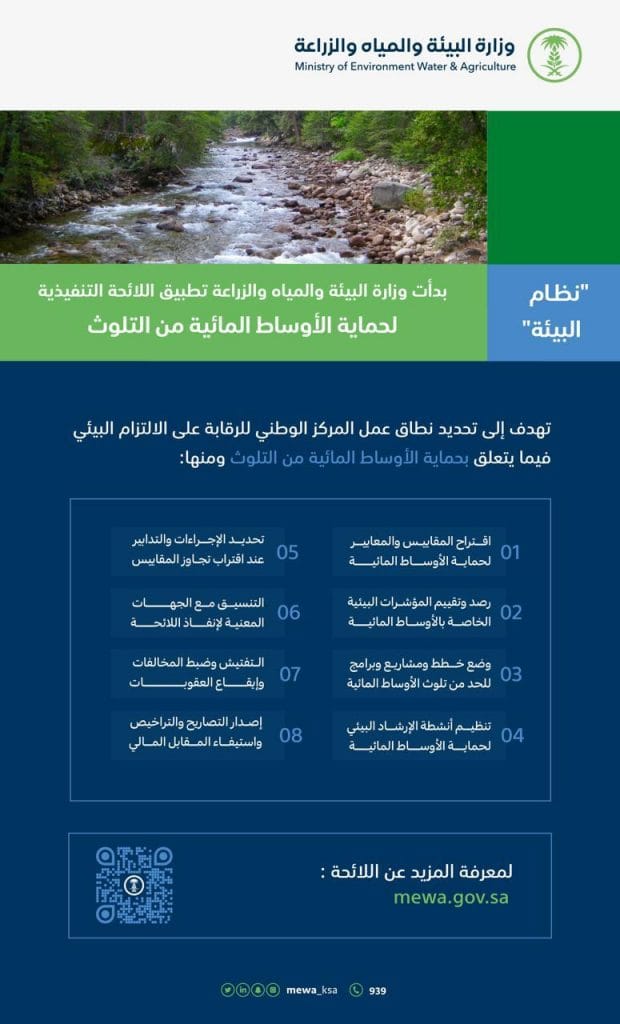
The Ministry of Environment, Water and Agriculture announced the start of the implementation of the executive regulations to protect aquatic environments from pollution in all regions of the Kingdom, based on the Environment Law issued by Royal Decree No. (M/165) on 11/19/1441 AH.
The Ministry of Environment, Water and Agriculture announced the start of the implementation of the executive regulations to protect aquatic environments from pollution in all regions of the Kingdom.
The ministry explained that the regulation applies to all persons and activities related to water bodies, and aims to define the scope of work of the National Center for Environmental Compliance Control with regard to protecting water bodies from pollution by proposing standards, criteria, controls and requirements, preparing and implementing plans aimed at reducing the pollution of water bodies and mitigating its effects, proposing programs, studies and research on water bodies, periodic monitoring and evaluation of environmental indicators, and determining the procedures and measures required when persons are about to exceed the standards related to water bodies
The Ministry emphasized that the regulation included a table of classification of penalties and violations, including: Failure to comply with the standards and techniques of treated wastewater before discharging it to the environmental media, failure to comply with the controls and requirements of licenses, carrying out one of the activities specified in the regulation without obtaining a permit, installing and operating ambient water monitoring and control networks without a license, and publishing any data related to ambient water quality without the approval of the center, and to know more about the regulation can access the ministry's website through the link: https://mewa.gov.sa/ar/InformationCenter/DocsCenter/RulesLibrary/Pages/default.aspx.
.The National Center for Environmental Compliance monitors the environmental compliance of all facilities with an impact on the environment in all development sectors, supervises programs to monitor environmental pollution sources and environmental media, monitors air, water and soil quality, approves environmental impact studies, issues environmental licenses for all development projects, environmental inspection on facilities, and coordinates with relevant authorities to improve environmental compliance through pollution monitoring, environmental assessment, control and guidance, in addition to tracking and monitoring pollution levels and sources.
The National Center for Environmental Compliance works to monitor the environmental compliance of all facilities with an impact on the environment in all developmental sectors, and supervises environmental pollution sources and environmental environment monitoring programs.