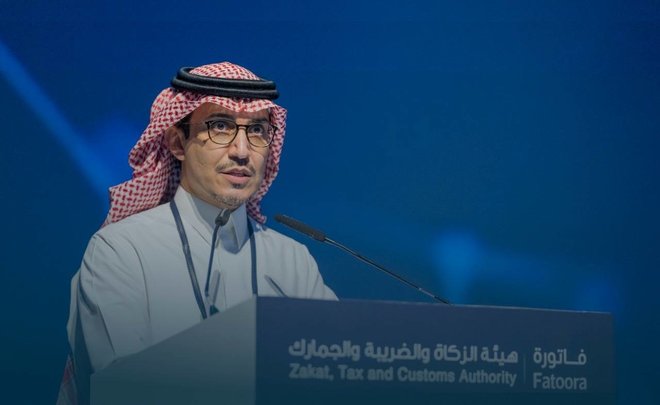

<The Zakat, Tax and Customs Authority launched the e-invoicing project “Fator” in Riyadh, in the presence of Engineer Suhail Abanmi, Governor of the Authority, Engineer Ahmed Al-Suwayan, Governor of the Digital Government Authority, Engineer Saleh Al-Rasheed, Governor of the General Authority for Small and Medium Enterprises (Monshaat), Ahmed Al-Suwailem, CEO of the Anti-Cover-Up Program, Ajlan Al-Ajlan, President of the Federation of Saudi Chambers and Chairman of the Board of Riyadh Chamber, and Engineer Yousef Al-Hurgan, CEO of the National Center for Government Resource Systems.
For his part, Abdullah Fintoukh, Project Manager for e-invoicing project “Fator” said. He said: “The project will contribute to reducing the transactions of the hidden economy and promoting fair competition, in addition to contributing significantly to the efforts made by various government agencies to combat commercial concealment. In addition to its essential role in enriching the consumer experience.”
He expressed his thanks to all parties cooperating in the implementation of the “Fatora” project, including providers of electronic billing services and systems, appreciating at the same time the enthusiasm and readiness of the owners and taxpayers to apply the requirements of electronic billing, who provided feedback that helped the Authority to reach this integrated form.
For his part, Saleh Al-Rasheed, Governor of the General Authority for Small and Medium Enterprises, stated that the Authority worked to correct a number of initiatives that enabled it to help the Authority in correcting the markets, one of which is the electronic invoice, which brings many benefits to enterprises, including providing a fair and attractive environment for growth and prosperity and its contribution to eliminating commercial cover-up, facilitating access to financing and banking facilities, as the electronic invoice ensures the existence of very accurate financial statements.
He added that Monshaat Bank contributed to increasing the percentage of financing for small and medium enterprises in Saudi Arabia from 2 percent in 2016 to 8 percent in the current year, pointing out that the bank helps reduce the financing gap for SMEs.
The application of the first phase will begin for taxpayers subject to the e-invoicing regulation starting from December 4 of this year 2021, which requires the issuance and maintenance of tax invoices and associated debit and credit notices in an electronic manner.
While the second phase will be implemented in a phased manner starting from January 1, 2023, which will be based on the consolidation of integration between the electronic systems of taxpayers and the systems of the Zakat, Tax and Customs Authority.
The ceremony witnessed the signing of agreements and the launch of the list of e-invoicing solution providers who have shown their readiness to provide e-invoicing solutions, as this comes in preparation for the start of the first phase (issuance and preservation phase) on December 4 of this year.<In this regard, the Authority emphasized that the list of e-invoicing solution providers that was launched during the ceremony is a non-binding indicative list, and its purpose lies in helping taxpayers to choose the appropriate technical solution for the size of the establishment and the type of sector, and the list is not understood to be limited to providing e-invoicing solutions to them, but the taxpayer is considered legal when he meets the requirements for e-invoicing.
It is noteworthy that the Authority launched during the last phase intensive campaigns that continue until the end of the year, with the aim of raising awareness of e-invoicing and the stages of application and the requirements necessary for its application, highlighting the intended benefits expected from the
For his part, Abdullah Fintoukh, Project Manager for e-invoicing project “Fator” said. He said: “The project will contribute to reducing the transactions of the hidden economy and promoting fair competition, in addition to contributing significantly to the efforts made by various government agencies to combat commercial concealment. In addition to its essential role in enriching the consumer experience.”
He expressed his thanks to all parties cooperating in the implementation of the “Fatora” project, including providers of electronic billing services and systems, appreciating at the same time the enthusiasm and readiness of the owners and taxpayers to apply the requirements of electronic billing, who provided feedback that helped the Authority to reach this integrated form.
For his part, Saleh Al-Rasheed, Governor of the General Authority for Small and Medium Enterprises, stated that the Authority worked to correct a number of initiatives that enabled it to help the Authority in correcting the markets, one of which is the electronic invoice, which brings many benefits to enterprises, including providing a fair and attractive environment for growth and prosperity and its contribution to eliminating commercial cover-up, facilitating access to financing and banking facilities, as the electronic invoice ensures the existence of very accurate financial statements.
He added that Monshaat Bank contributed to increasing the percentage of financing for small and medium enterprises in Saudi Arabia from 2 percent in 2016 to 8 percent in the current year, pointing out that the bank helps reduce the financing gap for SMEs.
The application of the first phase will begin for taxpayers subject to the e-invoicing regulation starting from December 4 of this year 2021, which requires the issuance and maintenance of tax invoices and associated debit and credit notices in an electronic manner.
While the second phase will be implemented in a phased manner starting from January 1, 2023, which will be based on the consolidation of integration between the electronic systems of taxpayers and the systems of the Zakat, Tax and Customs Authority.
The ceremony witnessed the signing of agreements and the launch of the list of e-invoicing solution providers who have shown their readiness to provide e-invoicing solutions, as this comes in preparation for the start of the first phase (issuance and preservation phase) on December 4 of this year.<In this regard, the Authority emphasized that the list of e-invoicing solution providers that was launched during the ceremony is a non-binding indicative list, and its purpose lies in helping taxpayers to choose the appropriate technical solution for the size of the establishment and the type of sector, and the list is not understood to be limited to providing e-invoicing solutions to them, but the taxpayer is considered legal when he meets the requirements for e-invoicing.
It is noteworthy that the Authority launched during the last phase intensive campaigns that continue until the end of the year, with the aim of raising awareness of e-invoicing and the stages of application and the requirements necessary for its application, highlighting the intended benefits expected from the