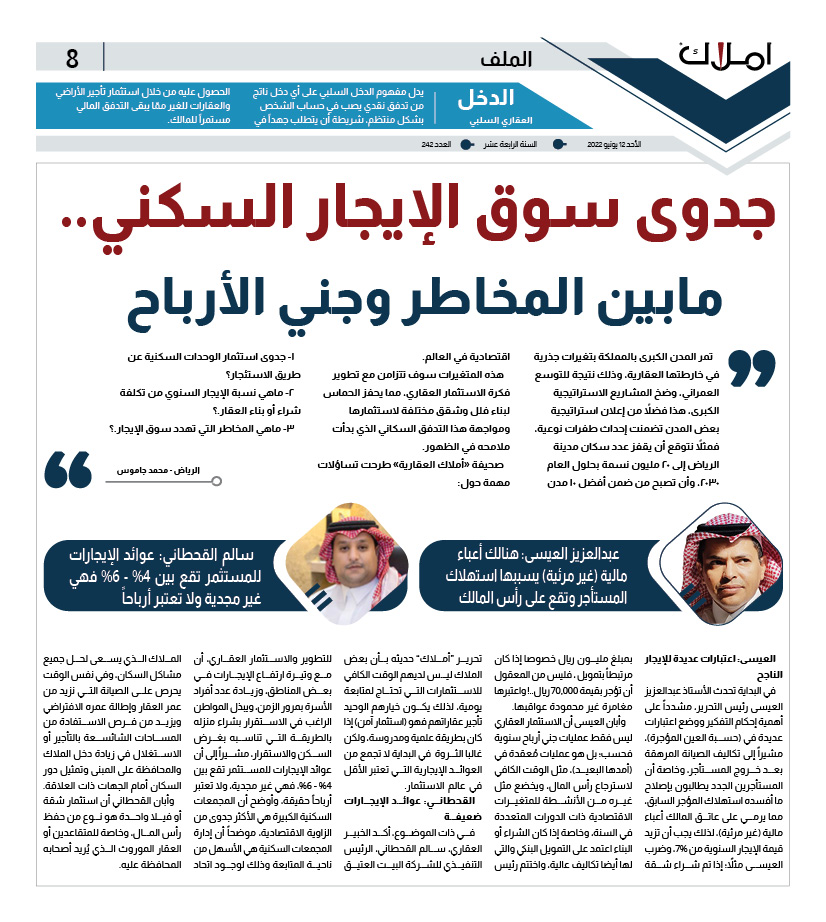

Abdulaziz Al-Issa: There are (hidden) financial burdens caused by the tenant’s consumption that fall on the landlord
Salem Al-Qahtani: Rental returns for investors range between 4% and 6%; they are not viable and are not considered profits
Riyadh—Mohammed Al-Amin Jamos
Major cities in the Kingdom are undergoing radical changes in their real estate landscape as a result of urban expansion and the launch of major strategic projects, not to mention the strategic plans announced by some cities that aim to bring about qualitative leaps. For example, we expect Riyadh’s population to surge to 20 million by 2030, and for it to become one of the top 10 economic cities in the world.
These changes will coincide with the growth of real estate investment, which is fueling enthusiasm for the construction of various villas and apartments for investment purposes and to accommodate this population influx, the signs of which are already beginning to emerge.
The newspaper “Amlak Real Estate” raised important questions about residential rental investment:
1- Is investing in residential units through rental viable?
2- What percentage of the purchase or construction cost of the property is the annual rent?
3- What risks threaten the rental market?
Al-Issa: Many Considerations for a Successful Lease
At the outset, Editor-in-Chief Abdulaziz Al-Issa spoke, emphasizing the importance of careful planning and taking numerous factors into account when calculating rental costs, pointing out the burdensome maintenance costs after a tenant moves out, especially since new tenants often demand repairs for damage caused by the previous tenant’s wear and tear, which places (hidden) financial burdens on the landlord, Therefore, the annual rent must be increased from 7%. Al-Issa gave an example: if an apartment is purchased for one million riyals—especially if it involves financing—it is unreasonable to rent it out for 70,000 riyals...! He considered this a risky venture with undesirable consequences.
Al-Issa clarified that real estate investment is not merely about reaping annual profits; but rather complex, long-term processes, such as the time required to recoup the principal, and—like other activities—it is subject to economic fluctuations that occur in multiple cycles throughout the year, especially if the purchase or construction relied on bank financing, which also entails high costs, The editor-in-chief of “Amlak” concluded by noting that some owners do not have enough time for investments that require daily monitoring, so their only option is to rent out their properties, which is a "safe investment" if done in a scientific and well-thought-out manner; however, wealth is rarely accumulated initially from rental income, which is considered the lowest-yielding option in the investment world.
Al-Qahtani: Rental Returns Are Low
On the same topic, real estate expert Salem Al-Qahtani, CEO of Al-Bayt Al-Atiq Real Estate Development and Investment Company, emphasized that with the rising pace of rents in some areas and the increase in family size over time, citizens seeking stability are purchasing homes in a manner that suits them for the purpose of housing and settling down. He noted that rental yields for investors range between 4% and 6%, which are not viable and do not constitute real profits, He explained that large residential complexes are the most economically viable, noting that managing such complexes is easier in terms of oversight due to the presence of a homeowners’ association that works to resolve all residents’ issues, At the same time, the association ensures maintenance, which extends the property’s lifespan and increases opportunities to utilize the spacious areas through leasing or other means to boost owners’ income, maintain the building, and represent residents’ interests before relevant authorities.
Al-Qahtani explained that investing in a single apartment or villa is a form of capital preservation, especially for retirees or in the case of inherited property that the owners wish to maintain.