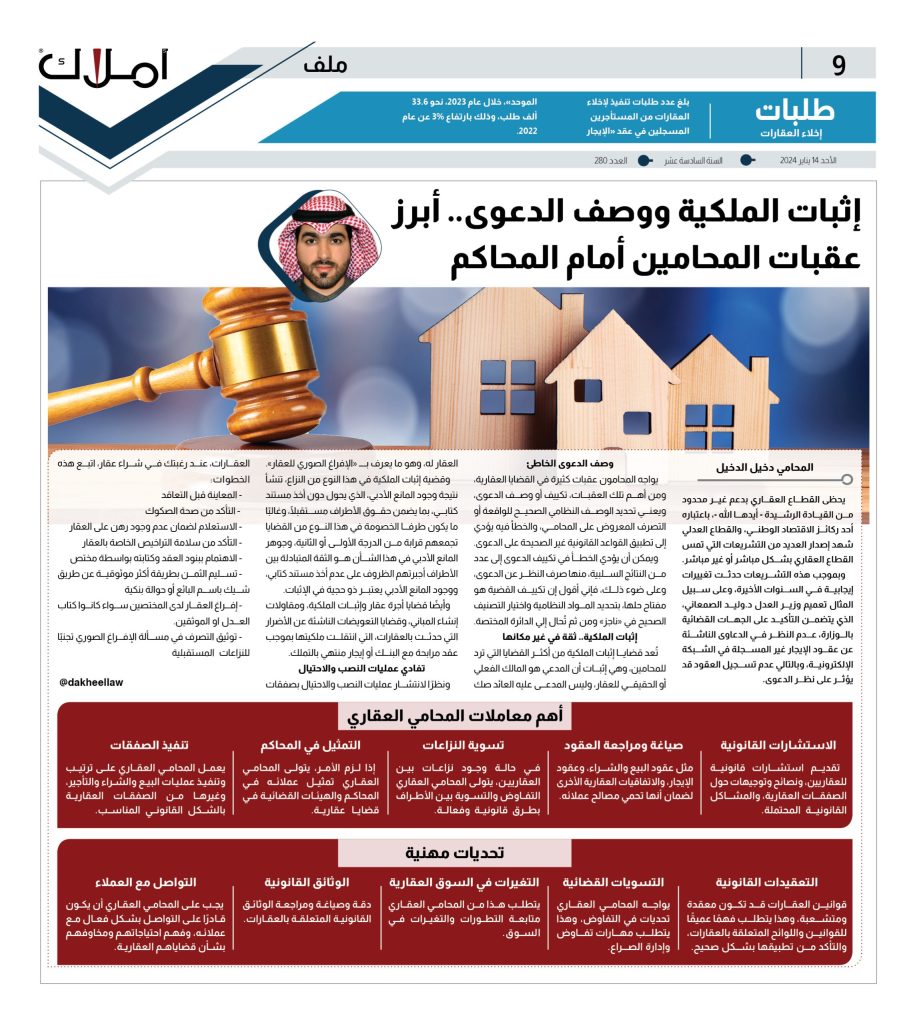

Proving ownership... and stating the cause of action are the main obstacles lawyers face in court
Dakhil Al-Dakhil, Attorney
The real estate sector enjoys the unwavering support of our wise leadership—may God support them—as one of the pillars of the national economy. The judicial sector has seen the enactment of numerous laws that directly or indirectly affect the real estate sector, and pursuant to these laws, positive changes have occurred in recent years. For example, the circular issued by His Excellency Minister of Justice Walid Al-Samaani, which instructs the Ministry’s judicial authorities not to consider cases arising from lease agreements that are not registered in the electronic network, Consequently, failure to register contracts may affect the adjudication of the case.
Incorrect Legal Characterization or Description of the Case
Lawyers face many obstacles in real estate cases, one of the most significant being the legal characterization or description of the case; This involves determining the correct legal characterization of the facts or transaction presented to the attorney; an error in this determination leads to the application of incorrect legal rules to the case. An error in the characterization of the case can result in a number of negative consequences, including dismissal of the case, In light of this, I maintain that the classification of a case is the key to its resolution: by identifying the relevant statutory provisions and selecting the correct classification in the case filing, after which it is referred to the competent court.
Proving Ownership… Misplaced Trust
Cases involving proof of ownership are among the most common cases brought before lawyers. They involve proving that the plaintiff is the actual or true owner of the property, rather than the defendant to whom the title deed is registered—a situation known as ”fictitious transfer of property.” A case involving proof of ownership in this type of dispute arises due to the existence of a moral impediment that prevents the parties from drawing up a written document to secure their future rights. Often, the parties to the dispute in such cases are related by first- or second-degree kinship, The essence of the moral impediment in this context is the mutual trust between the parties, which circumstances compelled them not to draw up a written document; the existence of this moral impediment is considered conclusive evidence.
This also applies to cases involving real estate rent, proof of ownership, building construction contracts, and claims for compensation arising from damage to real estate whose ownership was transferred under a murabaha contract with a bank or a lease-to-own agreement.
Avoiding Scams and Fraud
Given the prevalence of scams and fraud in real estate transactions, follow these steps when you wish to purchase a property: –
- Inspect the property before signing the contract.
- Verify the authenticity of the title deeds and ensure you inquire about them to confirm that there is no mortgage on the property, no outstanding debt, and no disputes related to the property.
- Verify that the property’s permits are in order.
- Pay close attention to the contract terms and ensure it is drafted by a professional.
- Pay the purchase price using a more reliable method, such as a check made out to the seller or a bank transfer specifying the reason for the transfer.
- Complete the property transfer with the appropriate professionals, whether notaries public or registered notaries.
- Ensure that the transfer of title is properly documented to avoid future disputes.
@dakheellaw