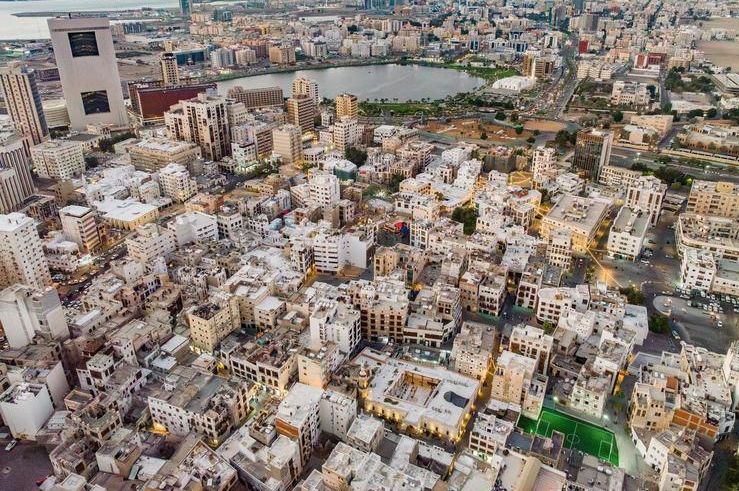

Completed The Historic Jeddah Program affiliated with the Ministry of Culture, in the first phase of the master plan, outlines a number of strategic objectives for the project, which include developing the living environment in the region to make it an attractive hub for business and cultural projects, a major destination for entrepreneurs, and the investment in its heritage sites and unique cultural and urban elements to build a vibrant living environment that fosters creativity, alongside leveraging the region’s history and cultural and urban elements to transform them into economic drivers, and creating an integrated environment featuring diverse natural elements, including waterfronts, green spaces, and open parks, in addition to highlighting the region’s abundant heritage landmarks, as it is a historical site unparalleled in the Kingdom.
Saving 233 Heritage Buildings
As part of efforts to preserve the region’s architectural heritage, the reinforcement and restoration of 233 heritage buildings—which feature rich architectural and heritage elements and were in danger of collapse—has been completed, 89 studies were also completed as the first phase of planning for building restoration work, and the restoration of 58 buildings was completed, in addition to the refurbishment and rehabilitation of 35 heritage buildings. The program has also completed the restoration of the historic Barha Beit Jokhdar and Barha Beit Al-Balad, in an effort to preserve the region’s architectural and historical values.
This follows the launch in 2021 by His Royal Highness Prince Mohammed bin Salman bin Abdulaziz, Crown Prince and Prime Minister—may God protect him—of the “Revitalization of Historic Jeddah,” as part of the Ministry of Culture’s Historic Jeddah Program, which unveiled a comprehensive development vision for the region, aiming to make it a global heritage destination in line with the Kingdom’s Vision 2030.
As part of the archaeological excavation project overseen by the program, the discovery of more than 25,000 archaeological artifacts was announced, the oldest of which date back to the early Islamic period, underscoring the region’s cultural and historical depth.
The archaeological discoveries unearthed at four sites in the region included 11,405 ceramic pieces, 1,730 shell artifacts, 685 building materials, and 191 glass objects. Among the most notable of these discoveries were wooden pieces from the pillars of the Mosque of Uthman ibn Affan—may Allah be pleased with him—dating back to the 1st century AH/7th century AD.
Addressing visual distortion
As part of efforts to improve the urban landscape of the area, the Historic Jeddah worked to achieve this goal by renovating building facades, maintaining sidewalks, and removing construction debris, to improve the quality of the urban environment, and enriching the experience of visitors to the area. Comprehensive maintenance and beautification work was carried out in the historic Al-Nada Market and Gold Street, one of the main streets in Historic Jeddah, contributing to the area’s aesthetic appeal. Additionally, world-class art installations were placed at several locations in Al-Arbaeen Lake Park, and the vast green spaces were professionally and uniquely landscaped.
In the same vein, to address visual clutter and add aesthetic touches to the area, the program maintained and beautified 150,000 square meters of roads, in addition to planting 120,000 square meters in various public spaces, and painting 140 buildings to improve the overall appearance, alongside the installation of suspended lighting along a 3,500-meter stretch in a number of public spaces.
The Historic Jeddah Program also ensured the application of the highest sustainability standards in the field of security and safety in the area, where 937 security personnel work with efficiency and professionalism to ensure the safety of visitors and property, which has contributed to a 250% increase in response rates, in addition to the installation of 304 high-quality surveillance cameras throughout the area, ensuring clear and comprehensive monitoring of all activity.
Approval of the Historic Jeddah Project Program
Out of the leadership’s commitment to preserving the region’s buildings and landmarks of significant historical importance, the Council of Ministers issued a decision in 2020 to transform the Historic Jeddah Administration, affiliated with the Ministry of Culture, into a program titled “The Historic Jeddah Project,” The program plays a comprehensive role in preserving and revitalizing the region’s cultural and architectural heritage through the implementation of a number of projects within the framework of the master plan for the Historic Jeddah Revitalization Project, as well as overseeing infrastructure improvement works in the region, and the restoration and rehabilitation of its buildings, thereby enriching the visitor experience and enhancing the area’s status as a major tourist destination.