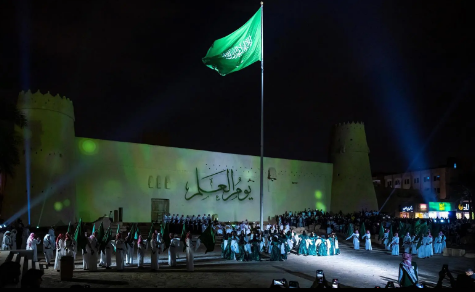

The Kingdom of Saudi Arabia celebrated yesterday, Tuesday, 11 Ramadan 1446 AH, corresponding to March 11, 2025 AD, “Flag Day“, the day on which King Abdulaziz bin Abdulrahman Al Saud, may God have mercy on him, approved the flag with its great connotations that indicate unity, justice, strength, growth and prosperity, on 27 Dhul Hijjah 1355 AH, corresponding to March 11, 1937 AD.
On this day, the value of the national flag extends throughout the history of the Saudi state since its establishment in 1139 AH corresponding to 1727 AD, which symbolizes the testimony of monotheism with the message of peace and Islam, on which this blessed state was founded, and the sword symbolizes strength, pride, high wisdom and prestige.
On this day, the value of the national flag extends throughout the history of the Saudi state since its establishment in 1139 AH corresponding to 1727 AD. <For nearly three centuries, the flag has been a witness to the unification of the Saudi state in all its stages, and the citizens of this country have taken it as an unbreakable banner of pride, according to the Saudi Press Agency “SPA”. <The national flag is a timeless value, a symbol of pride and honor, and an indication of the feelings of cohesion, love and loyalty stemming from the spirit of belonging and loyalty to the leadership and the homeland. The national flag carries the meanings of belonging and citizenship, the connotations of unity, strength, justice, growth and prosperity, and embodies the concept of the state, and expresses national unity and the historical depth of the homeland.
The history of the national flag dates back to the early 1900s. <The history of the Saudi national flag dates back to the banner carried by the imams of the first Saudi state, as the banner was green, woven of porcelain and ebresim, hung on a wooden pole or pole, with the inscription: “There is no god but God, Muhammad is the messenger of God.”
The flag continued with these specifications during the era of the first Saudi state, until the era of King Abdulaziz, may God have mercy on him, where two crossed swords were added to the flag, at a pivotal stage until the unification of the country, security and prosperity spread throughout the country, then the two swords were replaced at a later stage with a sword armed at the top, until the Shura Council submitted a proposal to King Abdulaziz, may God have mercy on him, who approved it on March 11, 1937, to place the sword under the words “There is no god but God and Mohammed is the messenger of God”, and settled the flag to what it is now.
The flag's shape was stipulated by the Shura Council. <The Flag Law issued in 1393 AH / 1973 AD stipulated that the flag of the Kingdom of Saudi Arabia shall be rectangular in shape, with a width equal to two-thirds of its length, green in color, extending from the flagpole to the end of the flag, with the word “There is no god but Allah, Muhammad is the messenger of Allah” in the middle and below it a sword armed parallel to it, whose grip is directed to the lower part of the flag. The two certificates and the sword are painted in white, clearly on both sides, with the two certificates written in the thuluth script, and its base is halfway between the width of the two certificates and the sword with a length equal to three-quarters of the drawing of the two certificates and at an equal distance from both sides.
The green color symbolizes growth and fertility, the white color symbolizes peace and purity, the sword symbolizes justice and security, and this symbolism of the sword has Arabic roots, as the sword is a symbol of nobility and chivalry among the Arabs, while the word Tawhid means proving the oneness of God and applying his wise law, and the sound approach on which our country was founded and walked in its three phases.
The Saudi flag is unique among the flags of the countries of the world with special features that have endowed it with an aura of majesty, reverence and magnificence, including that it is not draped over the bodies of dead kings and leaders, it is not lowered on sad occasions, it is not bowed to senior guests when reviewing the guard of honor, and its use as a trademark or for propaganda purposes that affect its majesty is prohibited.
The national flag is flown inside the Kingdom of Saudi Arabia. The national flag is flown inside the Kingdom on all government buildings and public institutions, and in its representations abroad, even during times of official holidays.
Believing in the Kingdom's belief in the importance of the national flag, it shall not be lowered on mournful occasions. Based on the belief of the Custodian of the Two Holy Mosques King Salman bin Abdulaziz Al Saud and His Royal Highness Prince Mohammed bin Salman bin Abdulaziz Al Saud, Crown Prince and Prime Minister - may God protect them - in the great importance of the flag as a manifestation of the Saudi state, its strength and sovereignty, and a symbol of cohesion, coalition and national unity, a royal decree was issued on 9 Sha'ban 1444H, corresponding to March 1, 2023, stipulating that (March 11) of each year be a special day for the flag (Flag Day).
For the first time in the history of the Kingdom of Saudi Arabia, the flag is a special day for the flag.