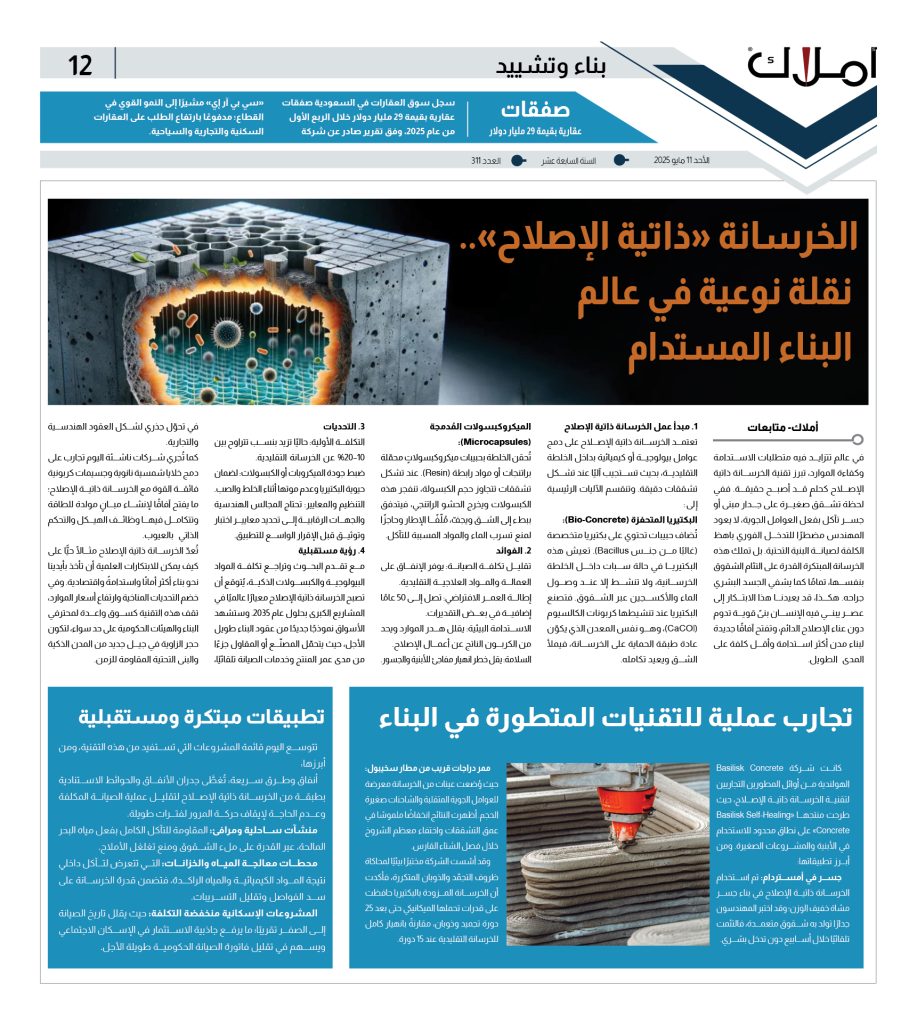

In a world of increasing demands for sustainability and resource efficiency, concrete technology is a self-repairing dream come true. The moment a small crack appears on the wall of a weathered building or bridge, the engineer no longer has to resort to immediate and expensive intervention to maintain the infrastructure. This innovative concrete has the ability to heal itself, just as the human body heals its own wounds. This innovation could bring us back to a time when humans build strong structures that last without the hassle of constant repair, and open up new possibilities for building more sustainable and less expensive cities in the long run.
-
Self-healing concrete working principle
Self-healing concrete is based on incorporating biological or chemical agents into the conventional mix, so that it responds automatically when micro-cracks form. The main mechanisms are divided into:
Catalytic Bacteria (Bio-Concrete
:Pellets containing specialized bacteria (often from the genus Bacillus) are added. These bacteria live in a dormant state within the concrete mix, and are only activated when water and oxygen come through the cracks. When activated, the bacteria make calcium carbonate (CaCO₃), the same mineral that normally forms the protective layer on concrete, filling the crack and reintegrating it.
Calcium carbonate (CaCO₃).
Microcapsules:
-
Benefits
Reduce the cost of maintenance: Saves spending on labor and materials.
Extended lifespan: Up to an additional 50 years in some estimates.
Environmental sustainability.
Environmental sustainability: Minimizes waste of resources and reduces the carbon footprint of repair work.
Safety: Reduces the risk of sudden collapse of buildings and bridges.
3. Challenges
Initial cost: Currently 10-20% more than conventional concrete.
Quality control of microbes or capsules: To ensure that bacteria are viable and do not die during mixing and pouring.
Regulation and standards: Engineering boards and regulatory agencies need to define testing and documentation standards before broad adoption.
-
Future Vision
As research advances and the cost of biomaterials and smart capsules declines, self-healing concrete is expected to become a global standard in major projects by 2035. Markets will see a new model of long-term construction contracts, where part of the product lifespan and maintenance services are automatically assumed by the manufacturer or contractor, radically transforming the form of engineering and commercial contracts. Startups are also experimenting with integrating solar nanocells and ultra-strong carbon nanoparticles with self-healing concrete, opening up the prospect of energy-generating buildings that integrate structural functionality and self-healing defect control.
<Self-healing concrete is a prime example of how scientific innovations can take us towards safer, more sustainable and economical construction. In the midst of climate challenges and rising resource prices, this technology stands as a promising market for construction professionals and government agencies alike, a cornerstone of a new generation of smart cities and time-resistant infrastructures.
Self-healing concrete is a prime example of how scientific innovations can take us toward safer, more sustainable, and more economical construction.
Practical trials of advanced technologies in construction
<The Dutch company Basilisk Concrete was one of the first commercial developers of self-healing concrete technology, introducing its product "Basilisk Self-Healing Concrete" on a limited scale for use in buildings and small projects. Notable applications include:
A bridge in Amsterdam: Self-healing concrete was used in the construction of a lightweight pedestrian bridge; engineers tested a wall that generated intentional cracks, which automatically healed within weeks without human intervention.
Basilisk Self-Healing Concrete was used in the construction of a lightweight pedestrian bridge. <A bike path near Schiphol Airport: Samples of concrete exposed to fluctuating weather conditions and oversized trucks were placed. The results showed a significant reduction in the depth of cracks and most cracks disappeared during the harsh winter. The company established an environmental laboratory to simulate repeated freezing and thawing conditions, confirming that the bacteria-infused concrete maintained its mechanical durability even after 25 freeze-thaw cycles, compared to the complete collapse of conventional concrete at 15 cycles.
Concrete with bacteria maintained its mechanical durability even after 25 freeze-thaw cycles, compared to the complete collapse of conventional concrete at 15 cycles.
-
Innovative and future applications
The list of projects that benefit from this technology is expanding, most notably:
Tunnels and highways: Tunnel walls and retaining walls are covered with a layer of self-healing concrete to minimize costly maintenance and eliminate the need to shut down traffic for long periods of time.
Coastal structures and harbors: Resist full corrosion by salty seawater, with the ability to fill cracks and prevent salt penetration.
Water treatment plants and harbors.
Water treatment plants and reservoirs: Subject to internal corrosion from chemicals and stagnant water, ensuring that the concrete is able to seal joints and minimize leaks.
Housing projects: Resistant to complete corrosion by salty seawater, through the ability to fill cracks and prevent salt penetration.
Low-cost housing projects: Reduces the maintenance history to almost zero, increasing the attractiveness of investing in social housing and reducing the government's long-term maintenance bill.