Amidst ongoing fluctuations in steel prices globally and increasing environmental pressures to reduce the carbon footprint of the building and construction sector, the search for new alternatives to traditional steel in structures is accelerating. Can these new materials achieve the difficult equation between economic efficiency, technical reliability and structural safety?
Materials such as engineered wood, fiberglass and basalt, high-performance concrete, and even treated bamboo are already taking shape on projects in Europe, Asia, and the Gulf, amid growing interest from developers and major construction companies.
The answer seems to be taking shape.
Engineered wood. Lightweight
<In Europe, especially Scandinavia, Mass Timber is emerging as a strong alternative to steel, with technologies such as Cross Laminated Timber (CLT) and Glulam. These materials combine light weight and durability, weighing less than a tenth of reinforced concrete, but offering tremendous resistance to vertical and horizontal loads.
Mass timber has been shown to be a powerful alternative to steel through technologies such as Cross Laminated Timber (CLT) and Glulam.
<Projects such as Wood City in Stockholm, Sweden, have shown that over 1,000 square meters per week can be built using these materials, while reducing carbon emissions by up to 40% compared to concrete and steel structures. Despite the challenges associated with fire and moisture, Swedish and British building codes allow engineered wood to be used in buildings up to 20 stories high, provided special fire protection systems are in place.
Fiberglass and Basalt... Time-Resistant
<Many countries, including Saudi Arabia and Egypt, are turning to fiber-reinforced polymer (FRP) rods, including glass fiber (GFRP), basalt (BFRP), and carbon (CFRP). These materials are extremely lightweight - 70 to 80% less mass than steel - as well as highly tensile strength and corrosion resistance.
Technical reports show that FRP bars can be made from glass fibers (GFRP), basalt (BFRP), and carbon (CFRP).
<Recent technical reports indicate that the use of GFRP in concrete piles increased their durability by between 18% and 22% compared to steel, with a significant reduction in the appearance of cracks. Basalt bars have also proven effective in coastal infrastructure projects such as the Jeddah Corniche and some of Qatar's Lusail projects, reducing the cost of long-term maintenance by up to 40%.
Despite these advantages, there are still concerns about the low "ductility" or the ability to absorb energy during earthquakes, prompting some engineers in California to adopt hybrid systems that combine steel and fiber to ensure complete structural safety.
Some engineers in California are considering hybrid systems that combine steel and fiber to ensure complete structural safety.
Bamboo is making a comeback
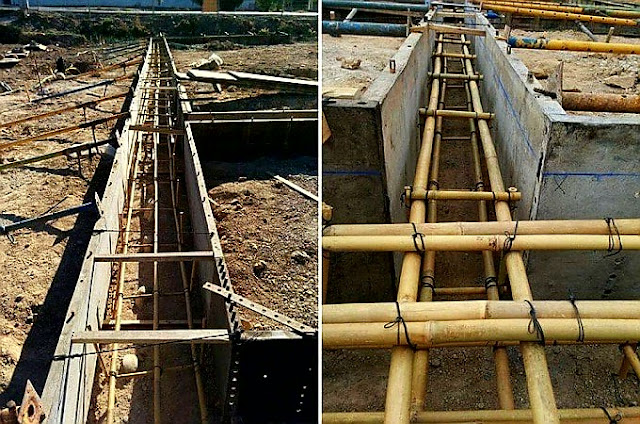
<Another alternative material seeing increased interest is bamboo, which has a high strength-to-weight ratio and flexibility that makes it suitable for seismic zones. Recent research suggests that it can be used in structures after being chemically treated to last up to 40 years. However, its high sensitivity to moisture and fungus makes it a less suitable option in humid climates such as the Red Sea and the Gulf, limiting its widespread use in the region.
Concrete without iron?
In parallel with these developments, new technologies have emerged in the world of concrete, most notably ultra-high performance concrete (UHPC) reinforced with mineral or synthetic fibers, which can act as reinforcement without the need for steel bars. The strength of this concrete has reached more than 150 MPa, compared to only 30 MPa in conventional concrete.
Ferrock, a new material made from steel dust that traps carbon dioxide during hardening, is currently one of the most environmentally promising materials, with five times the strength of conventional cement and negative emissions, but it is still limited to experimental applications due to the limited raw materials needed to produce it.
Ferrock concrete, a new material made from steel dust that traps carbon dioxide during hardening, is currently considered one of the most environmentally promising materials.
Regulatory standards and challenges
<Despite the engineering successes of these materials in several countries, the absence or weakness of regulatory codes in many Arab countries remains a barrier to widespread adoption. In this context, Saudi Arabia, through the Standards and Metrology Organization (SASO), has begun issuing standards for the use of basalt fibers, while Egypt is seeking to amend the Egyptian Code for Concrete (ECP 203) to include advanced uses of composite materials. Lack of awareness is also a barrier to widespread adoption.
<The lack of awareness among developers and financiers is an additional barrier, as these materials require specialized testing and careful design to take into account their unconventional properties, such as non-durable behavior or sensitivity to heat and moisture.
Economic Effectiveness
<Economically, these materials are still challenged by their initial cost, with estimates suggesting that the use of engineered wood or basalt bars raises the cost by between 10% and 25% compared to steel. However, the lifecycle savings - especially in infrastructure projects or buildings in coastal areas - may far outweigh this initial increase, through reduced maintenance costs, shorter construction time, and lower energy consumption.
Future taking shape
Although steel is still the backbone of construction structures, the shift to more sustainable, cost-effective and maintenance-friendly alternatives is inevitable in the face of environmental and economic challenges. As these materials gradually enter codes and standards, and awareness among designers and developers improves, the "post-iron" era seems to be taking shape.
The question remains.
<But the question remains: Do we trust these alternatives enough? The answer depends not only on global experiences, but also on the ability of Arab markets to embrace innovation, encourage smart solutions, and build trust through performance tests and rigorous standards. In this case, the question in the future may not be "Are they safe?", but “Why did it take us so long to use them?”.