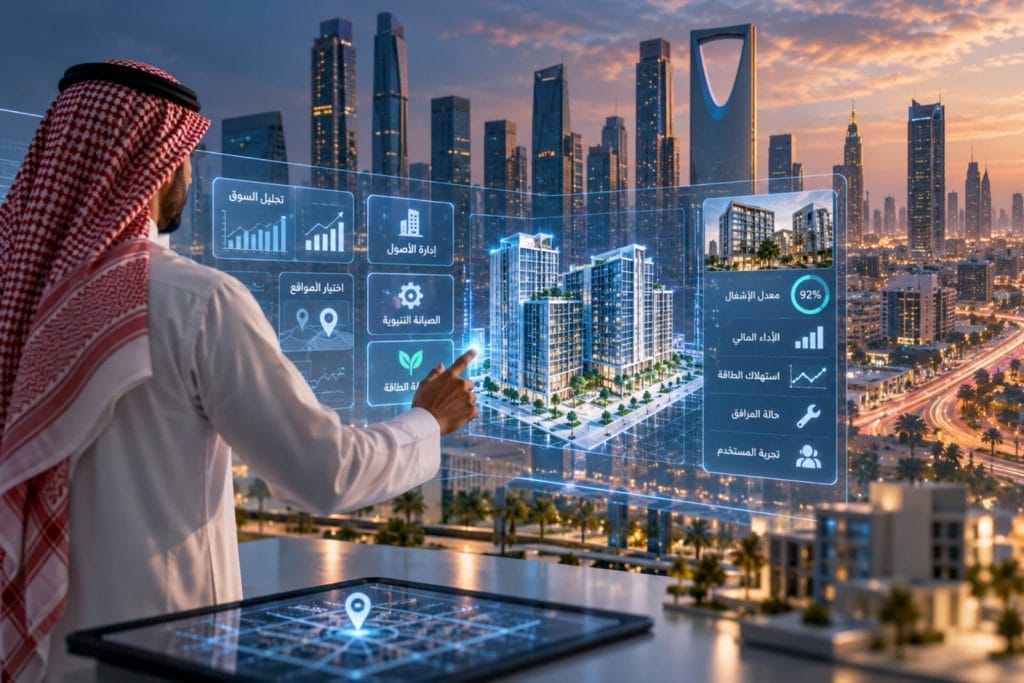
The outline of the King Abdullah Financial District appears to be taking shape, with the district standing out in northern Riyadh—featuring giant buildings with exquisite architectural designs that rise high, signaling the imminent inauguration of this distinctive financial hub, which the financial and business communities eagerly await to move there, heralding the start of a new era of excellence and leadership for the capital, Riyadh, which has transformed into a regional and international financial and economic hub.
Project Concept
The concept for the King Abdullah Financial District was launched in 2003 when the Custodian of the Two Holy Mosques, may God preserve him, announced this major project, which would strengthen the Kingdom’s financial and economic standing and help transform Riyadh into the economic and financial capital of the Middle East.
The Custodian of the Two Holy Mosques, King Abdullah bin Abdulaziz—may God preserve him—laid the cornerstone for this cultural landmark on Tuesday, 11/4/1427 AH, by announcing the establishment of a financial center in the city of Riyadh that would house official financial institutions, other financial entities, and all related facilities and services.
The project is being built along King Fahd Road in northern Riyadh on an area of approximately 1.6 million square meters, located between three major highways: King Fahd Road, the Northern Ring Road, and Al-Thumama Road. The project is divided into two parts extending on either side of Al-Thumama Road and connected by a land bridge that forms a spacious park spanning the highway. This center will be one of Riyadh’s most important cultural landmarks and is the first of its kind in the Middle East in terms of size, layout, and specifications.
Towers and Buildings
The center will include a number of towers and buildings housing administrative offices equipped with the finest facilities and office amenities, as well as residential buildings accounting for approximately 21% of the project’s total floor area, in addition to several five-star hotels managed by international companies specializing in hospitality services.
Center Amenities
The center consists of a number of key facilities, including hotels, a convention center, and financial services buildings. It will feature a collection of high-end five-star hotels; a number of international hotel companies have been invited to submit proposals to manage these hotels and the event venues that the center will host, and operating contracts have been signed with the largest international companies.Three of these hotels will be operated by a select group of world-renowned companies in this field that have been contracted, namely:Wyndham Hotels and Resorts, InterContinental, and Indigo InterContinental...
The center also features a massive conference center, distinguished by its luxury and beautiful design, evident in the unique architectural style of the Cultural Tent complex, which serves as a conference center and a hub for cultural and social activities and other events.
The building’s concept is based on an expansive, fragmented glass canopy reminiscent of a massive crystal tent, whose structure and design harmonize with the surrounding towers and buildings of the financial district, in an effort to link the local cultural heritage—the tent—with the dazzling architectural element of glass, through its fragmented, pioneering design. Inside, the building features luxurious lobbies and halls.
Modern Entertainment
The center features a number of attractions and recreational areas, carefully and skillfully designed to serve as a respite and a hub for entertainment and education for the complex’s residents and visitors. These consist of thirteen buildings distributed across several locations within the Valley area, These areas represent important elements of the Financial Center’s urban fabric, such as exhibition halls, markets, and conference and event centers. They include the Water Museum, the Built Environment Museum, the the Wellness and Recreation Club, the Museum, and other educational and recreational facilities.
The Monorail
To ensure transportation within the King Abdullah Financial District, developers have adopted a new and modern automated monorail system that meets all environmental and noise reduction requirements while blending seamlessly with its architectural surroundings.This is one of the center’s most distinctive features and includes an automated monorail line that will serve six stations, in addition to a main station for servicing and maintaining the twelve trains operated by an automated control system.
All of the center’s buildings are interconnected on the first floor via a large number of pedestrian bridges and suspended skywalks, which allow employees and visitors to move quickly and easily between the various buildings.These are air-conditioned, protected, and covered (indoor), which facilitates movement from one building to another while maintaining the same air-conditioned indoor environment and atmosphere.
Phases of the Center
The construction of the King Abdullah Financial Center is proceeding in several development phases in accordance with the project’s general construction plan. Under this plan, the project has been divided into three main development phases, based on which implementation is taking place, The targeted completion rates for each phase—covering buildings, infrastructure, facilities, and other components—are being achieved. These phases can be summarized as described on the center’s website as follows:
Phase One
A. Construction of Buildings: These are the buildings being constructed on ten plots of land and consist of 15 office, residential, and commercial towers, in addition to a five-star hotel and a mosque for the second zone. Most of the construction work for the buildings in this phase has been completed, and work is currently underway to complete the final finishes, in addition to a conference center and the grand mosque of the King Abdullah Financial Center. The completion rate for this phase is approximately 91%
B. Infrastructure Implementation: This includes the installation of water, electricity, cooling water, and irrigation systems, as well as the paving of internal roads, construction of utility tunnels and dual-level road tunnels, construction of four substations to supply the project with electricity, a waste collection building with an automatic vacuum system, and the construction of two central cooling stations. In addition, this phase includes signing agreements with a number of service providers to deliver their services to the project, such as the National Water Company, the Saudi Electricity Company, and telecommunications companies. The completion rate here is approximately 78%.
Phase Two
This phase will not affect the project’s operations or the start of occupancy by banks, companies, and residents:
A. Completion of the remaining buildings: These are being constructed on 30 plots of land and consist of 44 towers for office, residential, and commercial use, as well as two five-star hotels. The completion rate for this group is 67%
B- Infrastructure development: This includes the bridge connecting the two parts of the project, the monorail, the police and civil defense building, several schools, a medical clinic, and parking structures. Work is currently underway on the monorail.
C. Capital Market Authority Headquarters Tower: Work is currently underway on this tower, with a completion rate of approximately 51 %. This tower is the tallest in the King Abdullah Financial District
D. Buildings Constructed by Other Entities: These include the Tadawul Tower and the Samba Group Tower, which are currently being constructed by and under the management of those entities.
Phase Three
This phase will be completed during the current year, 2014, and includes the following:
A. External roads and bridges outside the project boundaries (surrounding the project)
B. Construction of attraction buildings: These consist of ten diverse attraction buildings designed to add an entertainment element to the project.