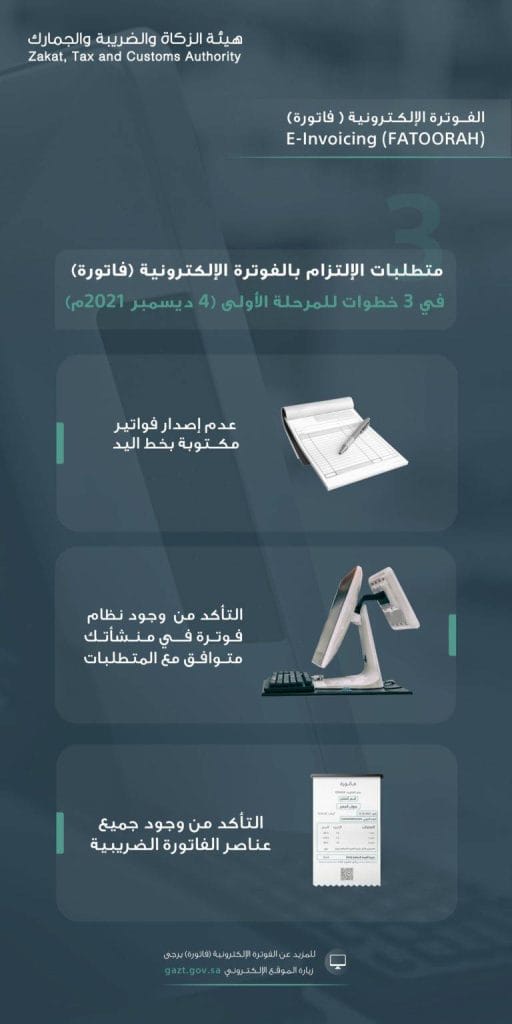

The Zakat, Tax, and Customs Authority has reiterated the importance of complying with the new tax system through three steps: using an invoicing system that meets the Authority’s requirements, issuing and retaining electronic invoices, and refraining from issuing invoices that are handwritten, created using word processing software, or scanned.
Phase 1 Requirements
The Authority noted that December 4 is the deadline for all taxpayers to implement electronic invoicing for their new tax invoices, and no handwritten or scanned invoices will be accepted, It noted that the most significant changes to the tax invoice include the optional addition of a QR code, the inclusion of the buyer’s VAT registration number if the buyer is registered for VAT, and the addition of the billing address.
The second phase will begin in early January 2023. In addition to the requirements of the first phase, the invoice must include the minimum required information, the encryption function (HASH) for the invoice or electronic notification, the encryption seal, and the public key used for the encryption seal (Public Key).
Warnings Against Tampering
The Zakat, Tax, and Customs Authority warned against tampering with electronic invoices or using more than one sequence per unit, or extracting or transferring the encryption key and altering the time, emphasizing that strict penalties await those who engage in such practices, and specifying that the minimum information that must be displayed to the consumer when scanning a QR code is the supplier’s name, the supplier’s VAT registration number, the invoice or notice timestamp, the date and time, and the total value including
For his part, Mohammed Al-Mihna, an advisor at the Authority, clarified that accounting software does not have to be cloud-based to comply with the tax regulations, noting that simplified tax invoices and related notices—which are typically issued by a business to an individual—must include a QR code (QR code) and the invoice address, while invoices issued by one business to another must include the purchaser’s VAT-registered name if the purchaser is a taxpayer.
Consumer Protection Through Enhanced Competition
The benefits of electronic invoicing are numerous, the most important of which are: Promoting a climate of fair competition and protecting consumers by providing a standardized mechanism for documenting and verifying invoices, combating the shadow economy, curbing front companies, enriching the consumer experience, and digitizing the consumer’s relationship with the supplier, in addition to increasing tax compliance by strengthening the verification of commercial transactions.
Al-Mihna noted that there are currently no accredited e-invoicing service providers, and taxpayers are required to use any system compatible with the Authority’s systems, Furthermore, the Authority has not yet mandated a specific file format for the first phase, and any format may be used, He noted that the electronic invoicing requirement applies to all taxpayers subject to tax in the Kingdom and any party that issues a tax invoice on behalf of a taxpayer subject to tax, with the exception of taxpayers who are not residents of the Kingdom.