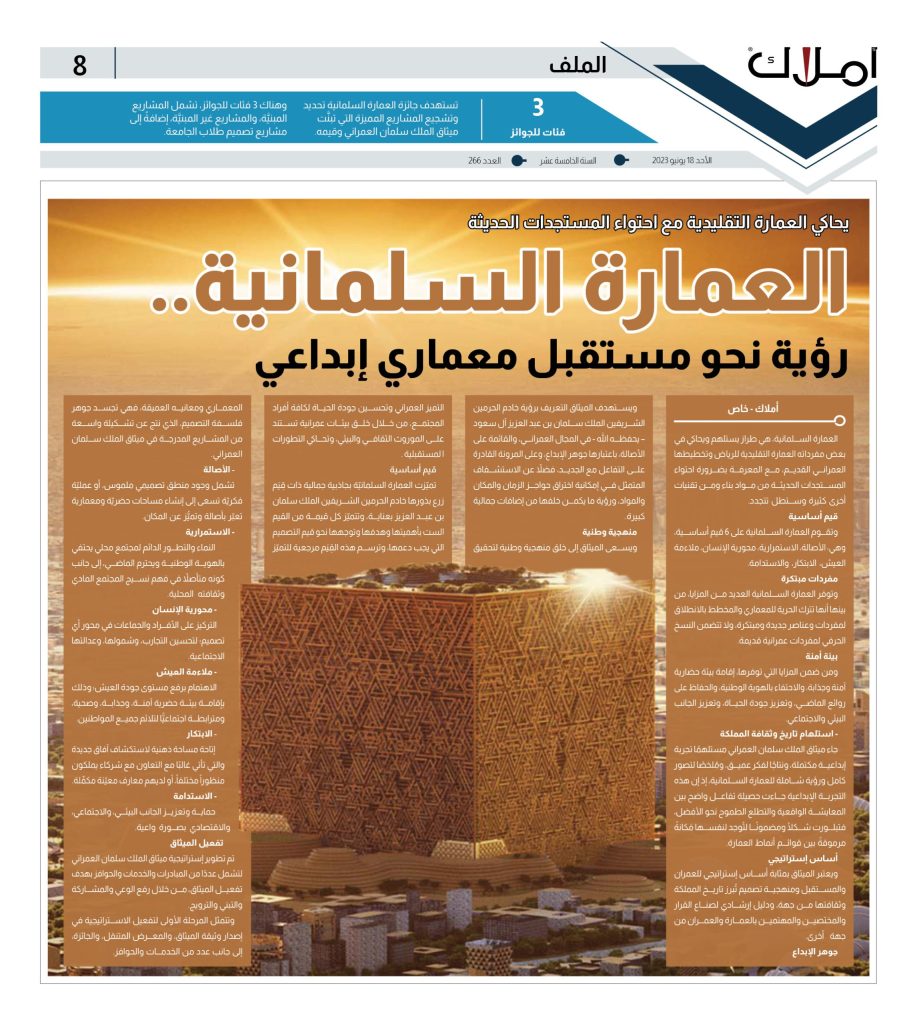

Salmani architecture is a style that draws inspiration and mimics in some of its vocabulary the traditional architecture of Riyadh and its ancient urban planning, while recognizing the need to embrace modern developments in building materials and many other techniques that will continue to evolve. <The Salmaniya Architecture is based on 6 core values: Authenticity, Continuity, Human Centeredness, Livability, Innovation, and Sustainability. Salmani architecture offers many advantages, including the fact that it leaves the architect and planner free to create new and innovative vocabulary and elements, and does not involve the literal copying of old architectural vocabulary.
Salmani architecture offers many advantages.
Among the advantages of Salmani architecture are the creation of a safe and attractive urban environment, celebrating the national identity, preserving past masterpieces, enhancing the quality of life, and promoting the environmental and social aspect.
Among the advantages that Salmani architecture provides are the creation of an urban environment that is safe and attractive.
Inspiring the Kingdom's history and culture
The King Salman Urban Charter was inspired by a complete creative experience, a product of deep thought, and a summary of a complete conceptualization and comprehensive vision for Salmani architecture, as this creative experience was the result of a clear interaction between real-life experience and ambitious aspiration for the best; it crystallized in form and content to create a prominent place for itself among the lists of architecture styles.
The King Salman Urban Charter is the result of a clear interaction between real-life experience and ambitious aspiration for the best; it crystallized in form and content to create a prominent place for itself among lists of architecture styles. The Charter is considered as a strategic basis for urbanism and the future, a design methodology that emphasizes the Kingdom's history and culture on the one hand, and a guide for decision makers, specialists and those interested in architecture and urbanism on the other hand.
The Charter aims to define the form and content of architecture. The charter aims to introduce the vision of the Custodian of the Two Holy Mosques King Salman bin Abdulaziz in the urban field based on originality as the essence of creativity, flexibility capable of interacting with the new, as well as the ability to penetrate the barriers of time, space and materials, and see what lies behind them of great aesthetic additions.
The charter aims to introduce the vision of the Custodian of the Two Holy Mosques King Salman bin Abdulaziz in the field of architecture and urbanism.
Salmaniya Architecture Charter Vision
Creating a national methodology to achieve urban excellence and improve the quality of life for all members of society; by creating urban environments based on cultural and environmental heritage, and simulating future developments.
Core Values
Salmani architecture is characterized by an aesthetic appeal with values carefully planted by the Custodian of the Two Holy Mosques King Salman bin Abdulaziz. Each of the six values is characterized by its importance, purpose and orientation towards design values to be supported. These values set a reference for architectural excellence and its deep meanings; they embody the essence of the design philosophy, which resulted from the wide range of projects included in the King Salman Urban Charter.Salmani architecture is characterized by an aesthetic appeal with values carefully planted by the Custodian of the Two Holy Mosques King Salman bin Abdulaziz.
Authenticity: A concrete design logic, or intellectual process that seeks to create urban and architectural spaces that authentically and distinctively express a place.
Authenticity
Continuity: The permanent growth and development of a local community that celebrates national identity and respects the past, while being rooted in an understanding of the physical fabric of the community and its local culture.
Continuity
Human Centricity: Focusing on individuals and communities at the center of any design; to improve experiences, inclusiveness, and social justice. Human Centricity:
Livability: Concern for raising the quality of life by creating a safe, attractive, healthy, socially connected urban environment for all citizens. Livability
Innovation: Creating the mental space to explore new horizons that often comes with collaboration with partners who have a different perspective, or have certain complementary knowledge.
Innovation.
Sustainability
Charter Activation Strategy
<The King Salman Urban Charter strategy has been developed to include a number of initiatives, services and incentives to activate the Charter through awareness, participation, adoption and promotion: Issuing the charter document, the traveling exhibition, the award, and a number of services and incentives.