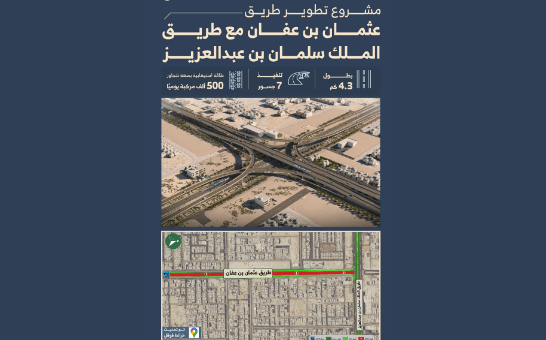

Royal Commission for Riyadh has started implementing the Othman bin Affan Road development project with King Salman Road, as part of its ongoing efforts to develop the road network and raise its operational efficiency to enhance traffic flow and improve the quality of transportation in the capital.
The Commission explained that the project extends 4. 3 km in length, and includes the construction of seven new bridges and the improvement of road lanes.The project includes the implementation of seven new bridges and the improvement of the road tracks, raising the capacity of the axis to about 500,000 vehicles per day and enhancing the connectivity between vital axes north of Riyadh.
The project includes the development of the main intersections with King Salman Road and Anas bin Malik Road through an integrated system of bridges ranging from two to four lanes, which contributes to enhancing the link between the south and north of King Salman Road, reducing travel times and increasing the efficiency of traffic movement in the region.<In conjunction with the start of construction work, the Authority activated a temporary traffic diversion on the road starting Thursday (May 21, 2026), as part of an integrated traffic plan implemented in coordination with the concerned authorities to ensure the flow of traffic at the highest levels of fluidity and safety.
The plan includes implementing the diversion in two phases, preparing three main lanes in each direction, completing signage and warning signs, updating map applications and systems, and dedicating a web page to follow the project updates and updates of the roads associated with it.
The project comes within the program to develop the axes of circular and main roads in Riyadh, which includes the implementation and development of more than 500 km of the road network, by raising the efficiency of existing axes, developing new roads, and enhancing their connectivity; in support of building an integrated and sustainable urban transport system and achieving the quality of life targets in the capital.