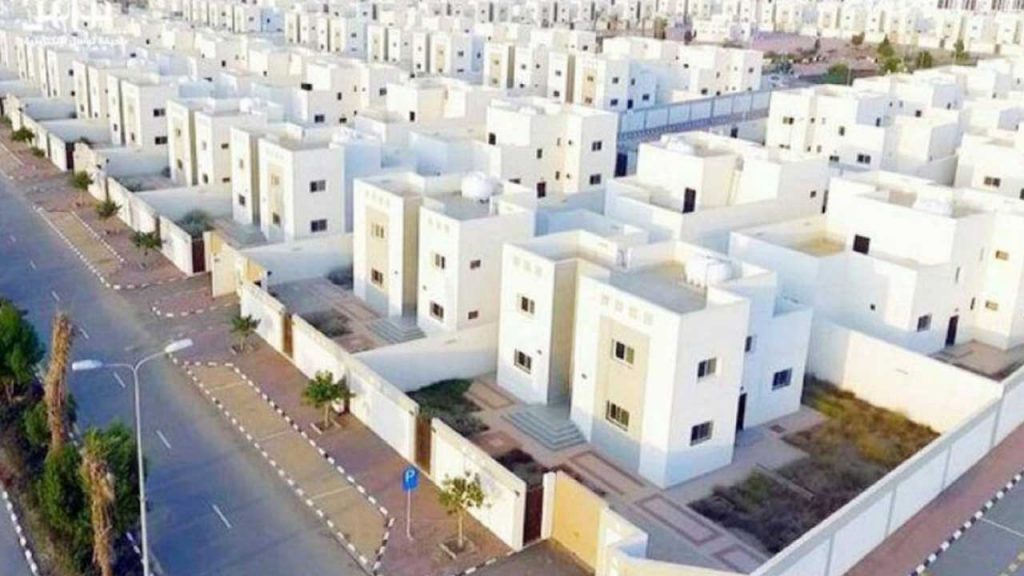

To mark the start of the resolution’s implementation, the Ministry of Municipal, Rural Affairs, and Housing has prepared mandatory regulations for fencing vacant lots within urban areas in cities, with the aim of ensuring the quality of the urban landscape and harmonizing their appearance with surrounding buildings in a civilized manner. According to the regulations, approval must be obtained from city councils and municipalities; fencing must be installed along the entire perimeter of the lot in accordance with a standardized design; the landowner is responsible for the safety of the sidewalk, as well as for lighting and landscaping on the sidewalk; and the lot must be located on major and arterial roads with highhigh traffic volumes as determined by municipal authorities.
Last April, the Ministry of Municipal and Rural Affairs and Housing granted owners of undeveloped land a six-month deadline to fence their properties, in accordance with the regulations governing the fencing of such land and in accordance with the relevant specifications and instructions; this was done to address the visual eyesore by erecting a fence within the boundaries of their legal ownership.
The Ministry has set a fine ranging from a minimum of one riyal to a maximum of 20,000 riyals, as a penalty for failing to fence or plant trees around land in areas designated by the municipality as it deems in the public interest, and in accordance with the specifications it establishes, as per the schedule of municipal violations displayed on the National Violations Platform (Efaa).
Regulations and Instructions:
- – The fence must be erected along the property line of the vacant lot.
- – Only one gate is permitted in the fence; it must open inward, be horizontal, and have a width of at least 2.4 meters.
- – The construction of annexes or any other structures within the vacant lot is prohibited.
- – All security and safety considerations must be taken into account when installing fence units.
- – The removal or cutting of any trees located on the sidewalks surrounding the site is prohibited.
- – The landowner is required to perform regular maintenance on the fence and repair any damaged sections.
- – It is prohibited to place any advertising materials on the fence without consulting the competent authority.
- – An engineering firm must be contracted to issue a permit for fencing vacant land.
- – The landowner bears full responsibility for the fence and for any damage caused to it.
- – Each entity shall fence its vacant land in coordination with the Municipality.
- – The fence around vacant land must be removed if any activity takes place on the land.
- – It is prohibited to use fenced-off vacant land for any commercial activity or as a parking lot.
- – Vacant land that is currently off-limits is not required to be fenced until the impediment is removed.
- – The regulatory authority at the Secretariat/Municipality shall inspect the sidewalk after completion of the work.
- – Obtaining a fencing permit and fencing the land does not exempt the owner from vacant land fees.
- – The Secretariat and the Municipality have the right to remove the fence in the event of non-compliance.
Stone Fence:
– Consists of wire mesh frames filled with stones appropriate to the nature of the area.
– High-density steel wire is used to construct the wire mesh frame.
– The steel mesh frame is (100–200) cm long, 30 cm wide, and 50–60 cm high.
– Each square in the frame measures 5×10 cm.
– A wooden plank is secured on top of the formwork to allow pedestrians to sit on it.
– Trees and plants suitable for growing among the stones may be planted on top of the formwork.
Concrete Wall
– Construct a lightweight concrete foundation on the ground to stabilize the wall, with a width of 0.70 m and a height of 0.20 m.
– A concrete wall 0.60 m high from the surface of the foundation.
– Secure the stones with cement mortar.
– Finish the top surface of the wall with stone or paint.
– Adhere to the design dimensions.
Unregistered Land:
– Post a notice on the land for 6 months stating that the land must be fenced and reviewed by the municipality or city secretariat.
– Coordinate with the Ministry of Justice to obtain the landowner’s information.
– The municipal authority or city council shall fence off the land one year after the notice is posted on the land, with the owner bearing the fencing costs upon review.
– Coordinate with the General Authority for State Real Estate to examine the transfer of land ownership to the state.